
Choosing a Battery Storage for your Solar Inverter in Nigeria
What Battery should I buy?

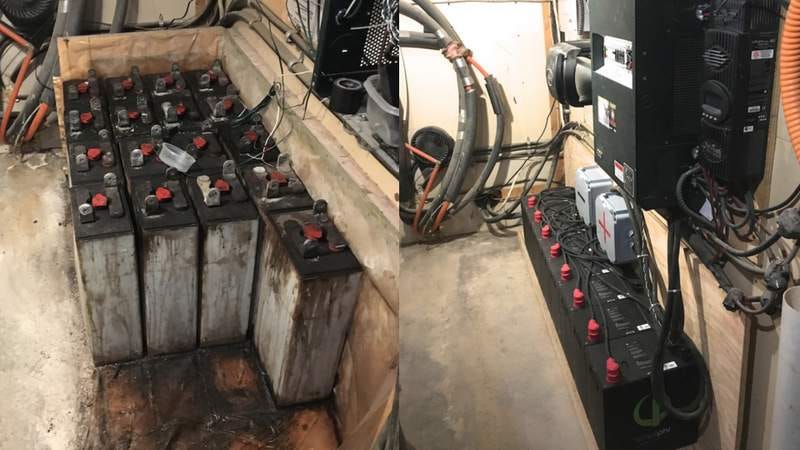
If you are like me, you probably hate it when the power goes out in Nigeria. It's not only inconvenient but also costly and frustrating. You never know when the electricity will come back on, and you have to rely on noisy and polluting generators to keep your appliances running.
That's why I decided to invest in a solar inverter system for my home. A solar inverter is a device that converts the direct current (DC) from the solar panels into alternating current (AC) that can power your household devices. It's a great way to save money on your electricity bills and reduce your carbon footprint.
But there's one problem: what do you do when the sun goes down?
How do you store the excess energy that your solar panels produce during the day? That's where battery storage comes in handy. A battery storage is a device that stores the DC power from the solar panels and provides it to the inverter when needed. It's like having a backup power source that can keep your lights on even when there's no sun.
But how do you choose the right battery storage for your solar inverter system? There are so many options available in the market, and they vary in size, capacity, price, and quality. How do you know which one is best for your needs and budget?
In this post, I will share with you some tips and tricks that I learned from my own experience of choosing a battery storage for my solar inverter system. I hope this will help you make an informed decision and avoid some common mistakes that I made along the way.
Tip #1: Know your power consumption
The first thing you need to do before buying a battery storage is to know how much power you consume on a daily basis. This will help you determine how big of a battery storage you need to meet your energy needs.
To calculate your power consumption, (hit me up with a DM and I will share an Excel sheet with you) you need to add up the wattage of all the devices that you use in your home. For example, if you have a TV that consumes 100 watts, a fridge that consumes 200 watts, and a fan that consumes 50 watts, your total power consumption is 350 watts.
But wait, there's more. You also need to consider how long you use each device per day. For example, if you use your TV for 4 hours, your fridge for 24 hours, and your fan for 8 hours, your total energy consumption is:
(100 watts x 4 hours) + (200 watts x 24 hours) + (50 watts x 8 hours) = 5.6 kilowatt-hours (kWh)
This means that you need battery storage that can provide at least 5.6 kWh of energy per day to power your devices.
Tip #2: Know your solar panel output
The next thing you need to do is to know how much energy your solar panels can produce per day. This will help you determine how fast you can charge your battery storage and how long it will last.
To calculate your solar panel output, you need to multiply the wattage of your solar panels by the number of peak sun hours in your location. Peak sun hours are the hours when the sun is shining at its brightest and most directly. You can find out the average peak sun hours for your location online or by using a solar calculator.
For example, if you have 4 solar panels that each produce 250 watts, and you live in Lagos where the average peak sun hours are 5.5 per day, your total solar panel output is:
(250 watts x 4 panels) x 5.5 hours = 5.5 kWh
This means your solar panels can produce enough energy to fully charge your battery storage in one day.
Tip #3: Choose the right type of battery
The last thing you need to do is to choose the right type of battery for your solar inverter system. There are different types of batteries available in the market, such as lead-acid, lithium-ion, nickel-cadmium, and nickel-metal hydride. Each type has its own advantages and disadvantages in terms of performance, lifespan, maintenance, cost, and environmental impact.
Here are some of the most common types of batteries and their pros and cons:
The first thing you need to know is that there are two main categories of battery storage types: lead-acid and lithium-ion. (for the experts here I am including Tubular as a type of Lead Acid)
Lead-acid batteries are the oldest and most widely used type of battery storage. They are cheap, reliable, and easy to maintain. However, they also have some drawbacks. They are heavy, bulky, and have a low energy density. This means that they take up a lot of space and require frequent charging and discharging. They also have a short lifespan and degrade over time.
Lithium-ion batteries are the newer and more advanced type of battery storage. They are light, compact, and have a high energy density. This means that they can store more energy in a smaller space and require less charging and discharging. They also have a longer lifespan and do not degrade as much as lead-acid batteries. However, they also have some drawbacks. They are expensive, sensitive to temperature and humidity, and require a sophisticated management system to prevent overcharging or overheating.
So, which type of battery storage is right for your solar inverter in Nigeria?
The answer depends on several factors, such as your budget, your space availability, your energy consumption pattern, and your environmental conditions. Here are some general guidelines to help you choose:
- If you have a low budget and a lot of space, you might want to go for lead-acid batteries. They are cheaper upfront and easier to install and maintain. However, you will need to replace them more often and pay more for their maintenance.
- If you have a high budget and limited space, you might want to go for lithium-ion batteries. They are more expensive upfront but will save you money in the long run. They will also take up less space and last longer. However, you will need to invest in a good management system and protect them from extreme temperatures and humidity.
Whatever type of battery storage you choose for your solar inverter in Nigeria, make sure that you do your research and consult with a professional installer before making a purchase.
You want to make sure that your battery storage system is compatible with your solar inverter system and meets your energy needs. You also want to make sure that your battery storage system is safe, secure, and environmentally friendly.
I hope this post has helped you understand the differences between lead-acid and lithium-ion batteries and how to choose the right one for your solar inverter in Nigeria.
If you have any questions or comments, please feel free to leave them below.
Grace to you!
TLDR
- Lead-acid: This is the oldest and most widely used type of battery for solar systems. It is cheap, durable, and easy to recycle. However, it has low efficiency, short lifespan, high maintenance, and high toxicity.
- Lithium-ion: This is the newest and most advanced type of battery for solar systems. It has high efficiency, long lifespan, low maintenance